

Asia Regenerative Academy





Environmentalism needs to work for everyone.
“Environmentalism without class struggle is just gardening.” -Chico Mendes
We live in a time of climate disruption, biodiversity loss, food-system challenges, and rapid technological change.
Environmental action can sometimes feel like something reserved for people who have the time, money, education, or access to make “sustainable choices.”
Buy organic. Drive electric. Consume less. Live greener.
But what happens when those choices simply aren’t available, or when they shift an ecological problem to another part of the world?
We believe environmental education needs to go beyond individual consumer choices.
We need to understand the systems behind the problems.
We need to connect environmental issues with social realities.
And we need to create spaces where people with different experiences can learn from one another.
That’s where ARA begins.
Collaborative Learning + Mutual Understanding
Through collaborative learning and mutual understanding, we bring different experiences and forms of knowledge into dialogue.
Ecopedagogy
Paulo Freire & Critical PedagogyInspired by critical pedagogy and Paulo Freire’s work, ecopedagogy encourages us to question how environmental and social problems are created, who they affect, and who has the power to shape change.
Ecopedagogy + Collaborative Learning to Regenerate
At ARA, we see education as more than learning about the environment. It is a way to understand the relationships between people, society, and the living world and to turn that understanding into action.
We learn to look beyond individual choices and examine the systems behind environmental challenges, including inequality, economic structures, corporate practices, and public policy, while connecting the framework to ancestral and Indigenous wisdom.
Participatory Action Research
Community as Co-ResearchersWe explore ways of making research more participatory.
Instead of communities simply becoming research subjects, they can participate in asking questions, collecting knowledge, interpreting findings, and deciding what happens next.
Study & Learning Circles
Dialogue Among EqualsWe use small-group learning to create space for dialogue.
Participants meet as equals, explore different perspectives, listen to one another, and work toward a deeper understanding of complex issues.
“Because sometimes the most important thing we can learn is how to listen to someone who sees the problem differently.”
Asset-Based Community Development
Strengths & AssetsWe don’t want to begin every conversation by asking: “What’s missing?” We also ask:
“What do we already have?”
Skills. Knowledge. Relationships. Spaces. Stories. Traditions. People.
We believe that communities already hold many of the resources they need to create change. We want to help make those assets visible and connect them.
Student Testimonials
What Our Students Say
Reflections from Universitas Indonesia communications students participating in ARA’s co-learning dialogues, systems thinking workshops, and regenerative frameworks.
Raissa Amany
Mahasiswi Komunikasi UI“Through ARA’s courses, weekly discussions, and Regenerative Dialogue Series, I explored climate communication, circular economy, doughnut economics, and systems thinking. I gained new perspectives on communicating complex sustainability issues in ways that are accessible, relevant, and meaningful.”
“For communication practitioners, sustainability knowledge helps us go beyond raising awareness. We can create stories that build public trust, provide context, and inspire people to take meaningful action.”
Sirhan Muhammad Dehya Alqolbi
Mahasiswa Komunikasi UI“ARA helped me see problems more holistically through systems thinking, strengthen my project management skills, and communicate climate change more effectively. What I appreciated most was how the different courses connected.”
“As communication practitioners, understanding sustainability is increasingly important. It helps us contribute not only to long-term business strategies, but also to a healthier relationship between people and nature. We are part of nature, not separate from it.”
Giovanni Merdika Selli
Mahasiswa Komunikasi UI“ARA introduced me to new perspectives on sustainability, from climate change and circular economy to regenerative development. I learned that sustainability is about more than the environment; it’s about understanding the connections between people, nature, and communities.”
“As communication practitioners, we need to understand the issues behind the messages we create. ARA taught me to look more critically at sustainability claims, consider different stakeholders, and communicate more responsibly. Good communication isn’t just about looking sustainable; it’s about building trust through messages that reflect meaningful action.”
The Regenerative Dialogue Series
Co-learning sessions hosted by Asia Regenerative Academy in collaboration with academic and community partners.

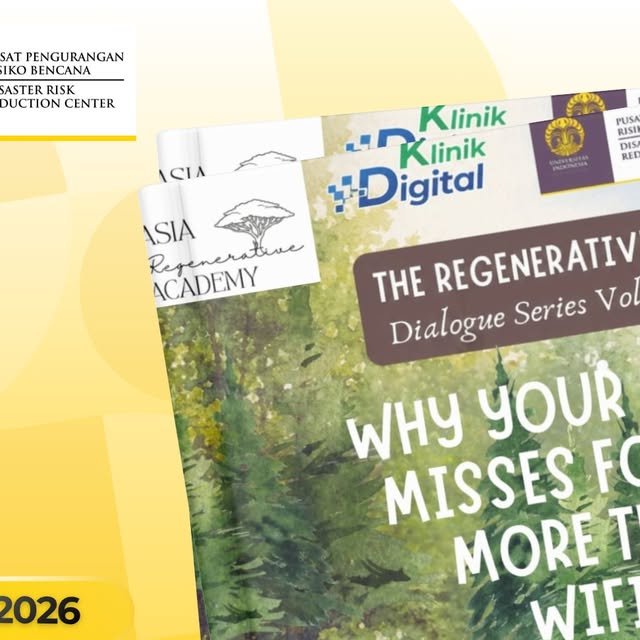
Why Your Brain Misses Forest More Than WiFi
Exploring nature connection, biophilia, and ecological psychology in partnership with Disaster Risk Reduction Center UI.
Ecological Mindset & Learning Spaces
Co-creating open spaces where practitioners, academics, and youth sit together as equal co-inquirers.

From One Straw Revolution to One Sqm of Resilience
Natural farming principles, food sovereignty, and micro-scale resilience in urban and rural settings.
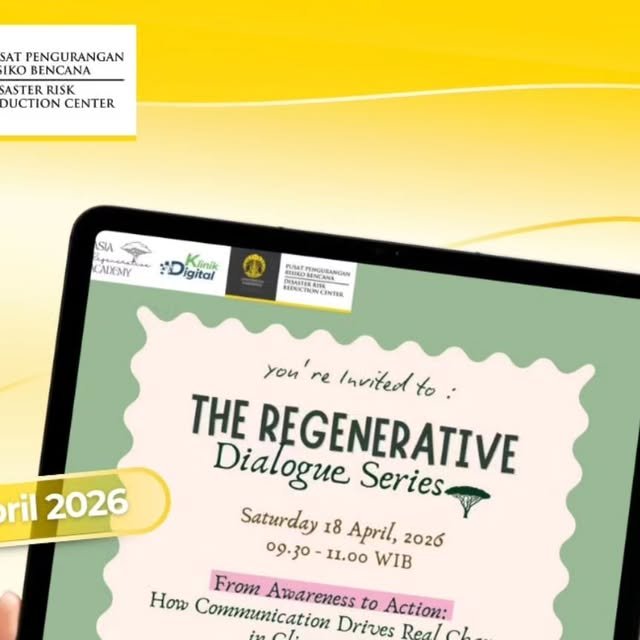
From Awareness to Action: Climate Communication
Bridging information awareness with actual behavioral change and grassroots environmental advocacy.